

Chances are you have seen the viral Saturday Night Live sketch ‘Sister’. It is a fake ad for an elder care service: skip the costly professional care and just text your sister, who drops everything to help. It makes light of something many families know all too well. When parents age, it is often the daughters who become the primary caregiver and turn their lives upside to care for their parents.
This sketch, even though it was meant as a joke, is a great example of what so many families have to go through and I felt a great opportunity to shed some light on what home care is really like for so many BC families.
A recent visit with one of our clients
I recently visited with one of our clients and their family. On paper, their mother was well supported. In practice, her family was running the whole operation and getting burnt out. Care for their mother came from five directions at once:
- Government home support. Hours approved by a health authority case manager and delivered by a contracted agency.
- A private home care agency. Added by the family to cover what the public hours do not.
- A privately hired caregiver. Someone who answers to the family rather than to any agency.
- A family doctor. Manages medical care and prescriptions, but sees her only in short appointments and is rarely in contact with the other providers.
- The family itself. They visit, schedule, check in, and fill every gap in between.
The family has also put their mother on a long-term care wait list, and she has been on it for over a year and still waiting. The wait list is not providing care, but the family is planning around it with no firm date.
Unfortunately, this is not an unusual family. After nearly 20 years in home care, we have seen this scene far too many times. Home care is not as straightforward as it should be, and that often forces people out of their homes sooner than they would like. For those with the resources and extensive family support, keeping a loved one at home is possible, but it is rarely as simple as it seems and comes at a cost, both financially and emotionally.
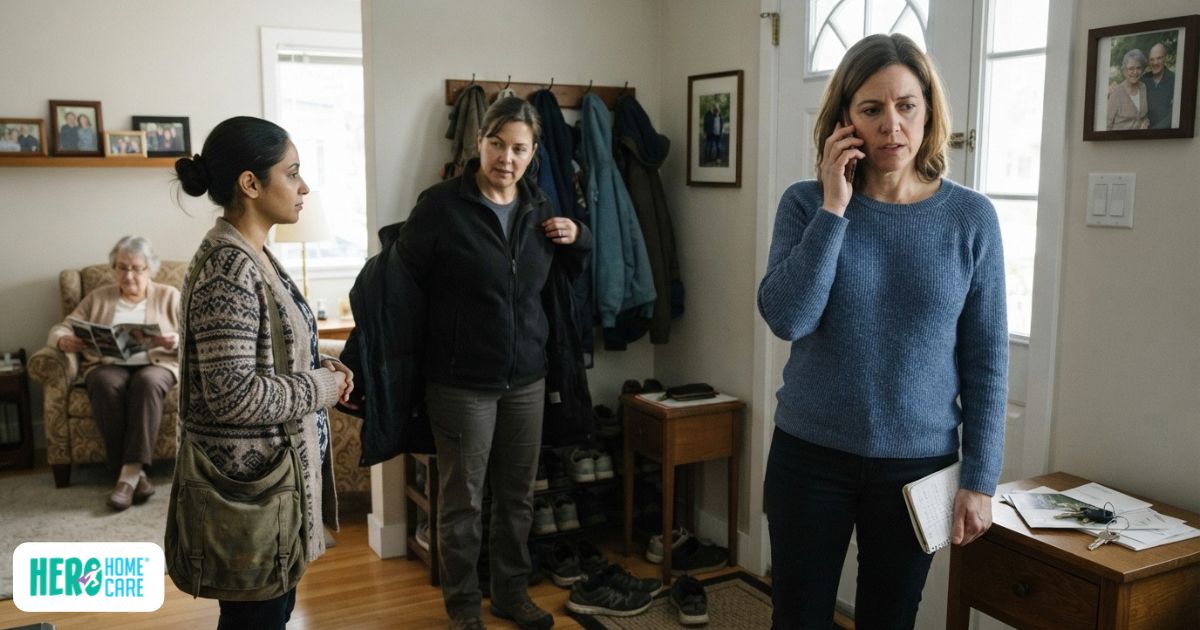
The family becomes the air traffic controller
Whoever steps up, whether it is a daughter, a son, a spouse or a friend, ends up doing the same job: relaying information between providers, chasing schedule changes, driving to appointments and filling every gap the system leaves.
Each source of care does its job, but each works from its own care plan, notes and schedule, and none of them are shared. If a government home support worker helps with medication on Tuesday morning, the private agency covering Tuesday evening may never find out.
Ontario’s NORC “Naturally Occurring Retirement Communities” Innovation Centre found the same pattern in apartment buildings where many older adults live. About 85% had two or more agencies delivering personal support care, and about 35% had four or more. Older adults described repeated assessments, unclear eligibility, and re-explaining their needs to different workers at each visit. These are Ontario figures, and even thought BC is structured differently, the experience will sound familiar to BC families.
One older adult interviewed for the report put it this way
“It feels like I’m an air traffic controller trying to manage my care.”
A broken system: We need to do better
The family in this story is filling gaps the system leaves, and many of those gaps come down to cost. Hero Home Care is part of two campaigns asking the government to make the changes needed to keep seniors at home and support family caregivers in caring for their aging parents.
Health Care Needs Home Care asks the BC government to remove the income-tested co-payment for publicly subsidized home support, so that access depends on care needs rather than income. The campaign was launched by a coalition of seniors’ groups, caregivers and health providers that says it represents more than 400,000 BC seniors. The BC Seniors Advocate has pointed out that a senior with a $31,000 annual income pays about $10,000 a year for one hour of daily subsidized home support, while most provinces, including Alberta and Ontario, charge nothing. Family caregivers already provide about 80% of home care, according to Family Caregivers of BC.
Homes Not Hospitals, a campaign from the BC Care Providers Association, makes the case for care at home. One of its priorities is an Aging in the Right Place tax credit, which would help offset what seniors and families pay out of pocket for home health and independent living services. The goal reflects what people want: a 2020 National Institute on Aging survey found that 91% of Canadians, and nearly all of those 65 and older, want to stay in their homes as long as possible.
Together, these two campaigns address the same problem from both sides: making public home support more affordable, and easing the cost for families who pay for care themselves.

How Hero Home Care becomes your air traffic controller
Every Hero Home Care client has a nurse-led care team, so the person coordinating your family’s care is a clinician, not just a scheduler. We are also a contracted provider of government-funded home support, so we understand the public system from the inside and can bring it together with private care. With our clinical expertise behind that, we support families from the big picture, not only task by task.
In practice, we coordinate across government home support, private agencies, privately hired caregivers and the family, keep one care plan, flag changes early, and help families through the wait for long-term care.
If you are coordinating care for a parent, spouse or friend and feel like you are running the control tower, you do not have to do it alone. Reach out to our Care Navigator to learn about the different options out there or to book a free in-home Care Consult with one our Care Managers by calling 1-888-988-9913 or emailing us at care@herohomecare.ca.